Uncertainty-Aware Remaining Lifespan Prediction from Images
Tristan Kenneweg, Philip Kenneweg, Barbara Hammer
2025-06-17
Summary
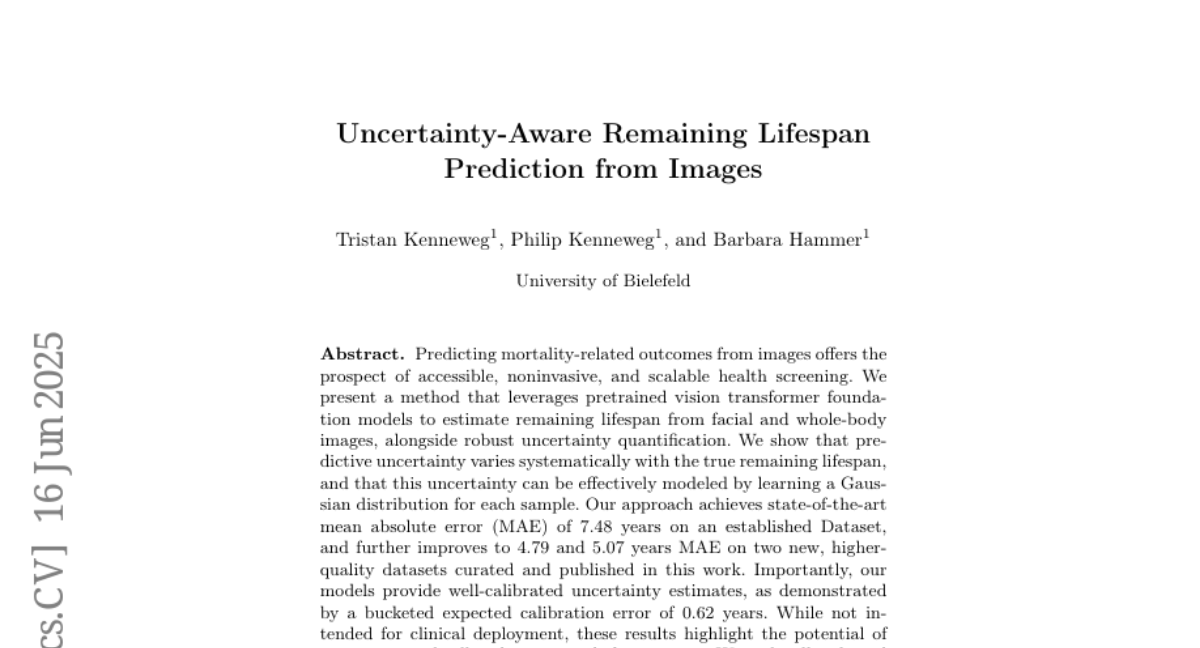
This paper talks about a new method that uses vision transformer models, which are advanced AI systems designed to analyze images, to predict how much longer a person might live based on pictures of their face or body. The method not only predicts the remaining lifespan with high accuracy but also estimates how confident and uncertain the predictions are, which helps understand the reliability of the results.
What's the problem?
The problem is that predicting how long someone will live by just looking at images is very difficult because many factors affect lifespan and it's hard for AI models to give accurate and trustworthy predictions. Also, it’s important that the AI can say how sure it is about its predictions because guessing wrong can have serious consequences if used in real health applications.
What's the solution?
The solution presented in the paper is to use pretrained vision transformer models that analyze facial and whole-body images, combined with a way to measure uncertainty by learning a probability distribution for each prediction. This lets the AI not only make accurate lifespan estimates but also provide well-calibrated uncertainty scores showing how reliable the estimates are. They improved accuracy by carefully training and testing on several datasets, and shared their code and data for others to build on.
Why it matters?
This matters because being able to estimate remaining lifespan accurately from images could lead to easier, noninvasive, and scalable health screenings in the future. The well-calibrated uncertainty means the system knows when it might be wrong, making predictions safer to use. Overall, it shows that images hold valuable health information that AI can unlock, potentially helping doctors and patients with early warnings and better care decisions.
Abstract
Vision transformer models predict remaining lifespan from images with high accuracy and well-calibrated uncertainty estimates.