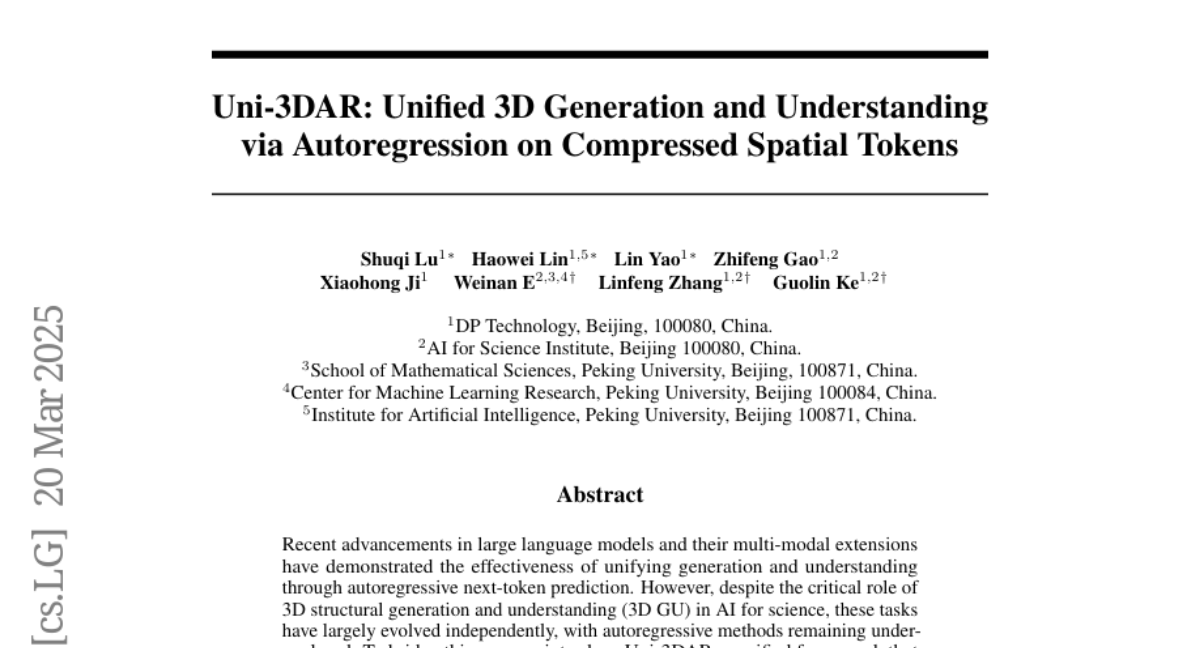
Uni-3DAR: Unified 3D Generation and Understanding via Autoregression on Compressed Spatial Tokens
Shuqi Lu, Haowei Lin, Lin Yao, Zhifeng Gao, Xiaohong Ji, Weinan E, Linfeng Zhang, Guolin Ke
2025-03-21
Summary
This paper is about creating a way for AI to both generate and understand 3D structures, like molecules or crystals, in a single process.
What's the problem?
Usually, AI models for 3D generation and understanding are separate. It's hard to make them work together efficiently.
What's the solution?
The researchers developed a system called Uni-3DAR that uses a clever way to compress 3D information and then predicts the structure step-by-step. This allows the same AI to both create and understand 3D objects.
Why it matters?
This work matters because it can speed up research in fields like drug discovery and materials science by allowing AI to design and analyze 3D structures more efficiently.
Abstract
Recent advancements in large language models and their multi-modal extensions have demonstrated the effectiveness of unifying generation and understanding through autoregressive next-token prediction. However, despite the critical role of 3D structural generation and understanding ({3D GU}) in AI for science, these tasks have largely evolved independently, with autoregressive methods remaining underexplored. To bridge this gap, we introduce Uni-3DAR, a unified framework that seamlessly integrates {3D GU} tasks via autoregressive prediction. At its core, Uni-3DAR employs a novel hierarchical tokenization that compresses 3D space using an octree, leveraging the inherent sparsity of 3D structures. It then applies an additional tokenization for fine-grained structural details, capturing key attributes such as atom types and precise spatial coordinates in microscopic 3D structures. We further propose two optimizations to enhance efficiency and effectiveness. The first is a two-level subtree compression strategy, which reduces the octree token sequence by up to 8x. The second is a masked next-token prediction mechanism tailored for dynamically varying token positions, significantly boosting model performance. By combining these strategies, Uni-3DAR successfully unifies diverse {3D GU} tasks within a single autoregressive framework. Extensive experiments across multiple microscopic {3D GU} tasks, including molecules, proteins, polymers, and crystals, validate its effectiveness and versatility. Notably, Uni-3DAR surpasses previous state-of-the-art diffusion models by a substantial margin, achieving up to 256\% relative improvement while delivering inference speeds up to 21.8x faster. The code is publicly available at https://github.com/dptech-corp/Uni-3DAR.