Unified Multimodal Understanding and Generation Models: Advances, Challenges, and Opportunities
Xinjie Zhang, Jintao Guo, Shanshan Zhao, Minghao Fu, Lunhao Duan, Guo-Hua Wang, Qing-Guo Chen, Zhao Xu, Weihua Luo, Kaifu Zhang
2025-05-08
Summary
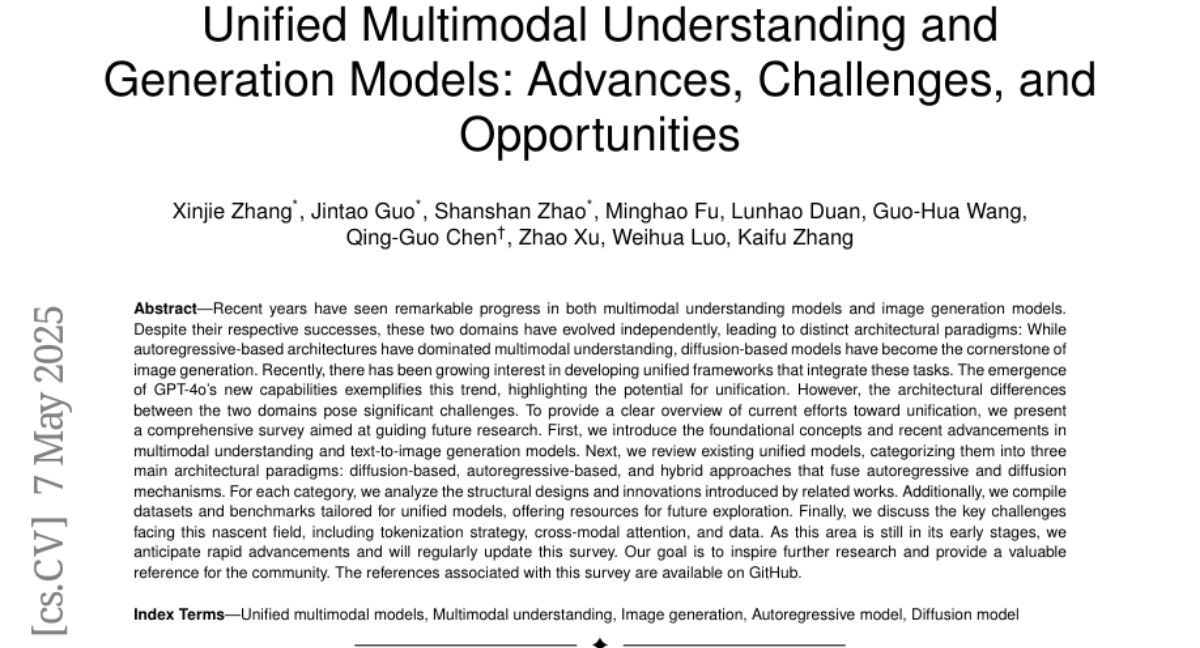
This paper talks about the latest progress in AI models that can both understand and create different types of information, like text and images, all at once. It reviews how these models work, the different ways they are built, and the main challenges that researchers face in making them better.
What's the problem?
The problem is that while there are many AI models that are good at either understanding or generating text and images separately, it's much harder to build models that can do both tasks together in a smooth and unified way. Combining these abilities is complicated and comes with technical challenges.
What's the solution?
The researchers surveyed the field and grouped the current models into three main types based on how they work: diffusion-based, autoregressive-based, and hybrid approaches. They also discussed what makes these models difficult to build and what needs to be improved for the future.
Why it matters?
This matters because having AI that can understand and create both text and images together opens up a lot of possibilities, like smarter digital assistants, better creative tools, and more natural ways for people to interact with technology. By understanding the challenges and progress, researchers can focus on making these models even more powerful and useful.
Abstract
A survey examines the integration of multimodal understanding and image generation models, categorizing them into diffusion-based, autoregressive-based, and hybrid approaches, and discussing challenges and future research directions.