Unified World Models: Coupling Video and Action Diffusion for Pretraining on Large Robotic Datasets
Chuning Zhu, Raymond Yu, Siyuan Feng, Benjamin Burchfiel, Paarth Shah, Abhishek Gupta
2025-04-09
Summary
This paper talks about Unified World Models (UWM), a new AI system that helps robots learn by watching videos and practicing actions, combining both to make them smarter and more adaptable.
What's the problem?
Current robot training needs perfect examples with labeled actions, which are hard to get, while tons of unlabeled videos exist but can’t be used effectively.
What's the solution?
UWM uses two AI processes—one for videos and one for actions—in a single system, letting robots learn from both labeled action data and unlabeled videos by adjusting how much each process influences the learning.
Why it matters?
This helps robots learn faster and better using all kinds of video data, making them more useful in real-world tasks like home assistance or factory work without needing perfect training examples.
Abstract
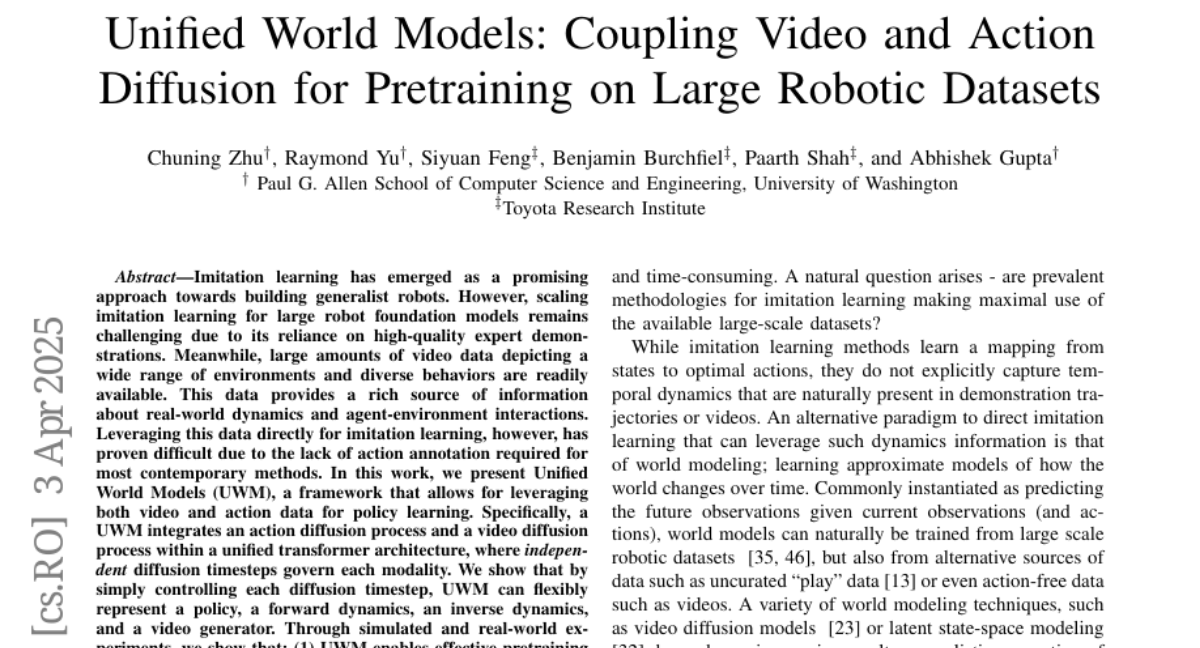
Imitation learning has emerged as a promising approach towards building generalist robots. However, scaling imitation learning for large robot foundation models remains challenging due to its reliance on high-quality expert demonstrations. Meanwhile, large amounts of video data depicting a wide range of environments and diverse behaviors are readily available. This data provides a rich source of information about real-world dynamics and agent-environment interactions. Leveraging this data directly for imitation learning, however, has proven difficult due to the lack of action annotation required for most contemporary methods. In this work, we present Unified World Models (UWM), a framework that allows for leveraging both video and action data for policy learning. Specifically, a UWM integrates an action diffusion process and a video diffusion process within a unified transformer architecture, where independent diffusion timesteps govern each modality. We show that by simply controlling each diffusion timestep, UWM can flexibly represent a policy, a forward dynamics, an inverse dynamics, and a video generator. Through simulated and real-world experiments, we show that: (1) UWM enables effective pretraining on large-scale multitask robot datasets with both dynamics and action predictions, resulting in more generalizable and robust policies than imitation learning, (2) UWM naturally facilitates learning from action-free video data through independent control of modality-specific diffusion timesteps, further improving the performance of finetuned policies. Our results suggest that UWM offers a promising step toward harnessing large, heterogeneous datasets for scalable robot learning, and provides a simple unification between the often disparate paradigms of imitation learning and world modeling. Videos and code are available at https://weirdlabuw.github.io/uwm/.