VBench-2.0: Advancing Video Generation Benchmark Suite for Intrinsic Faithfulness
Dian Zheng, Ziqi Huang, Hongbo Liu, Kai Zou, Yinan He, Fan Zhang, Yuanhan Zhang, Jingwen He, Wei-Shi Zheng, Yu Qiao, Ziwei Liu
2025-03-28
Summary
This paper is about creating a better way to test how well AI-generated videos stick to real-world rules and make sense, not just look good.
What's the problem?
Current tests for AI-generated videos mainly focus on whether the videos look realistic, but they don't check if the videos follow the laws of physics, common sense, or basic human anatomy.
What's the solution?
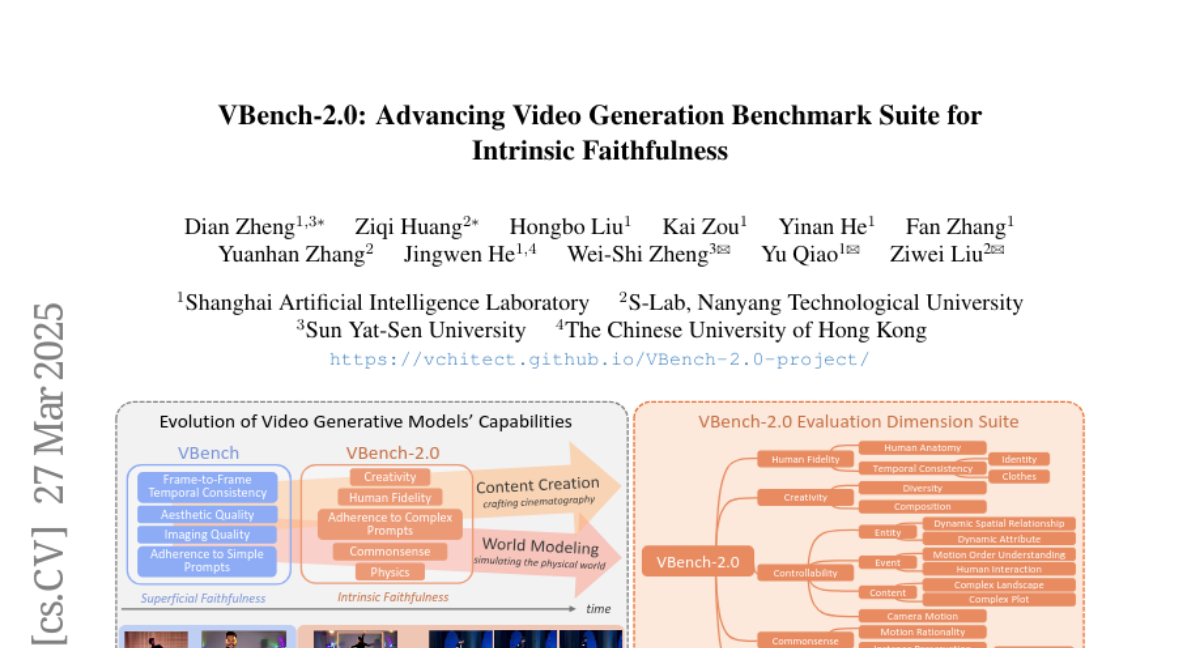
The researchers developed a new benchmark called VBench-2.0 that evaluates AI-generated videos on key dimensions like how well they represent humans, their controllability, creativity, adherence to physics, and common sense.
Why it matters?
This work matters because it sets a new standard for evaluating video-generating AI, pushing it to create videos that are not just visually appealing but also realistic and believable, which is crucial for applications like AI-assisted filmmaking and simulated world modeling.
Abstract
Video generation has advanced significantly, evolving from producing unrealistic outputs to generating videos that appear visually convincing and temporally coherent. To evaluate these video generative models, benchmarks such as VBench have been developed to assess their faithfulness, measuring factors like per-frame aesthetics, temporal consistency, and basic prompt adherence. However, these aspects mainly represent superficial faithfulness, which focus on whether the video appears visually convincing rather than whether it adheres to real-world principles. While recent models perform increasingly well on these metrics, they still struggle to generate videos that are not just visually plausible but fundamentally realistic. To achieve real "world models" through video generation, the next frontier lies in intrinsic faithfulness to ensure that generated videos adhere to physical laws, commonsense reasoning, anatomical correctness, and compositional integrity. Achieving this level of realism is essential for applications such as AI-assisted filmmaking and simulated world modeling. To bridge this gap, we introduce VBench-2.0, a next-generation benchmark designed to automatically evaluate video generative models for their intrinsic faithfulness. VBench-2.0 assesses five key dimensions: Human Fidelity, Controllability, Creativity, Physics, and Commonsense, each further broken down into fine-grained capabilities. Tailored for individual dimensions, our evaluation framework integrates generalists such as state-of-the-art VLMs and LLMs, and specialists, including anomaly detection methods proposed for video generation. We conduct extensive annotations to ensure alignment with human judgment. By pushing beyond superficial faithfulness toward intrinsic faithfulness, VBench-2.0 aims to set a new standard for the next generation of video generative models in pursuit of intrinsic faithfulness.