Video-R1: Reinforcing Video Reasoning in MLLMs
Kaituo Feng, Kaixiong Gong, Bohao Li, Zonghao Guo, Yibing Wang, Tianshuo Peng, Benyou Wang, Xiangyu Yue
2025-03-28
Summary
This paper explores how to improve the ability of AI models to reason about videos by using a technique called reinforcement learning.
What's the problem?
AI models often struggle to understand and reason about videos, especially when it requires understanding the order of events or relationships between objects.
What's the solution?
The researchers developed a new method that uses reinforcement learning to train the AI model to make better decisions when reasoning about videos, and they also incorporated high-quality image data to improve the model's understanding.
Why it matters?
This work matters because it can lead to AI systems that can better understand and interact with the world through video, which has applications in areas like robotics, self-driving cars, and video games.
Abstract
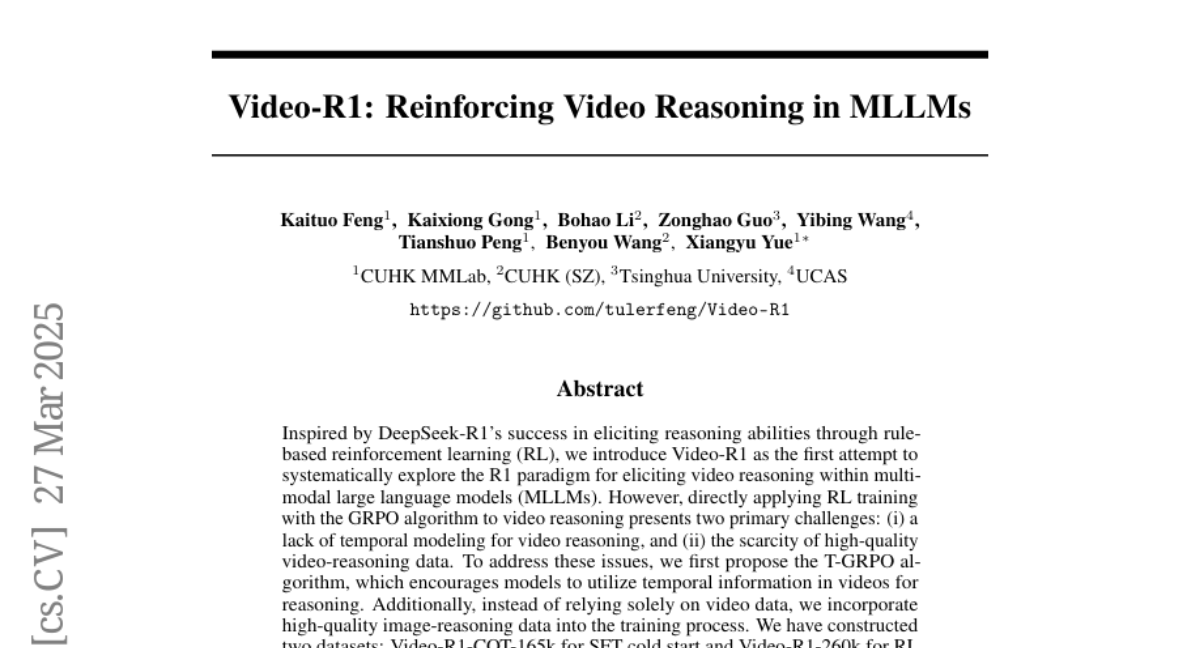
Inspired by DeepSeek-R1's success in eliciting reasoning abilities through rule-based reinforcement learning (RL), we introduce Video-R1 as the first attempt to systematically explore the R1 paradigm for eliciting video reasoning within multimodal large language models (MLLMs). However, directly applying RL training with the GRPO algorithm to video reasoning presents two primary challenges: (i) a lack of temporal modeling for video reasoning, and (ii) the scarcity of high-quality video-reasoning data. To address these issues, we first propose the T-GRPO algorithm, which encourages models to utilize temporal information in videos for reasoning. Additionally, instead of relying solely on video data, we incorporate high-quality image-reasoning data into the training process. We have constructed two datasets: Video-R1-COT-165k for SFT cold start and Video-R1-260k for RL training, both comprising image and video data. Experimental results demonstrate that Video-R1 achieves significant improvements on video reasoning benchmarks such as VideoMMMU and VSI-Bench, as well as on general video benchmarks including MVBench and TempCompass, etc. Notably, Video-R1-7B attains a 35.8% accuracy on video spatial reasoning benchmark VSI-bench, surpassing the commercial proprietary model GPT-4o. All codes, models, data are released.