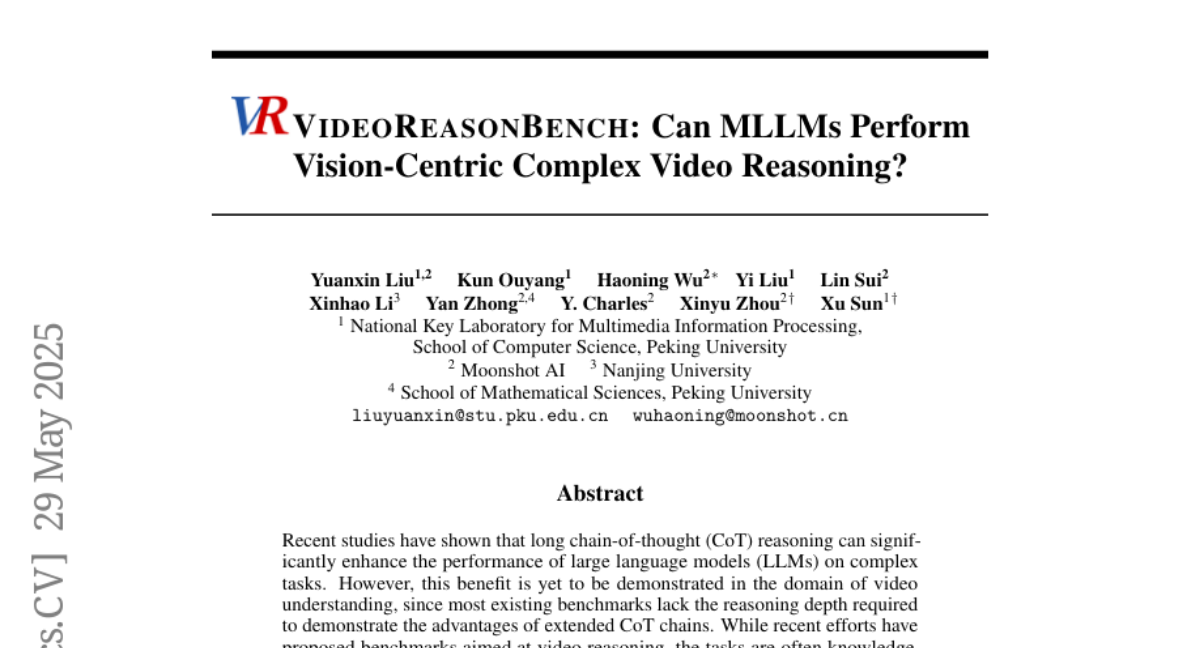
VideoReasonBench: Can MLLMs Perform Vision-Centric Complex Video Reasoning?
Yuanxin Liu, Kun Ouyang, Haoning Wu, Yi Liu, Lin Sui, Xinhao Li, Yan Zhong, Y. Charles, Xinyu Zhou, Xu Sun
2025-05-30
Summary
This paper talks about VideoReasonBench, a new way to test how well AI models can watch videos and figure out complicated things that happen in them, focusing on how much reasoning and thinking the AI needs to do.
What's the problem?
The problem is that current AI models often struggle to understand and explain complex events in videos, especially when they have to connect different pieces of information or think through what happened over time. Existing tests don't always push the AI to use deeper reasoning skills.
What's the solution?
The researchers created VideoReasonBench, a benchmark that specifically measures how well AI models can handle video tasks that require a lot of careful thinking and reasoning. They found that giving the AI more time and resources to think—what they call an extended thinking budget—makes a big difference in how well it can solve these complex video problems.
Why it matters?
This is important because it shows that to get smarter AI that can really understand videos like people do, we need to let it think more deeply and not just rush to quick answers. This could lead to better AI for video analysis in areas like security, sports, and education.
Abstract
A new benchmark, VideoReasonBench, evaluates complex vision-centric video reasoning, finding that extended thinking budgets are crucial for improved performance compared to existing benchmarks.