Vision-Language-Action Models: Concepts, Progress, Applications and Challenges
Ranjan Sapkota, Yang Cao, Konstantinos I. Roumeliotis, Manoj Karkee
2025-05-09
Summary
This paper talks about Vision-Language-Action models, which are AI systems that can see, understand language, and take actions, and reviews how these models have improved, how they are trained, and where they are used.
What's the problem?
The problem is that getting AI to not only understand what it sees and reads but also to act in the real world is extremely challenging. These models need to connect vision, language, and decision-making all at once, which is tough because each part is complicated on its own and even harder to combine.
What's the solution?
The researchers provided a detailed overview of the latest breakthroughs in these models, explained different ways they are trained, and showed how they are being used in real-world situations like robotics, gaming, and assistive technologies. They also discussed the current difficulties and suggested ideas for making these models even better in the future.
Why it matters?
This matters because Vision-Language-Action models could lead to smarter robots, better virtual assistants, and more helpful AI in everyday life. Understanding the progress and challenges helps scientists and engineers create technology that can interact with the world in more human-like and useful ways.
Abstract
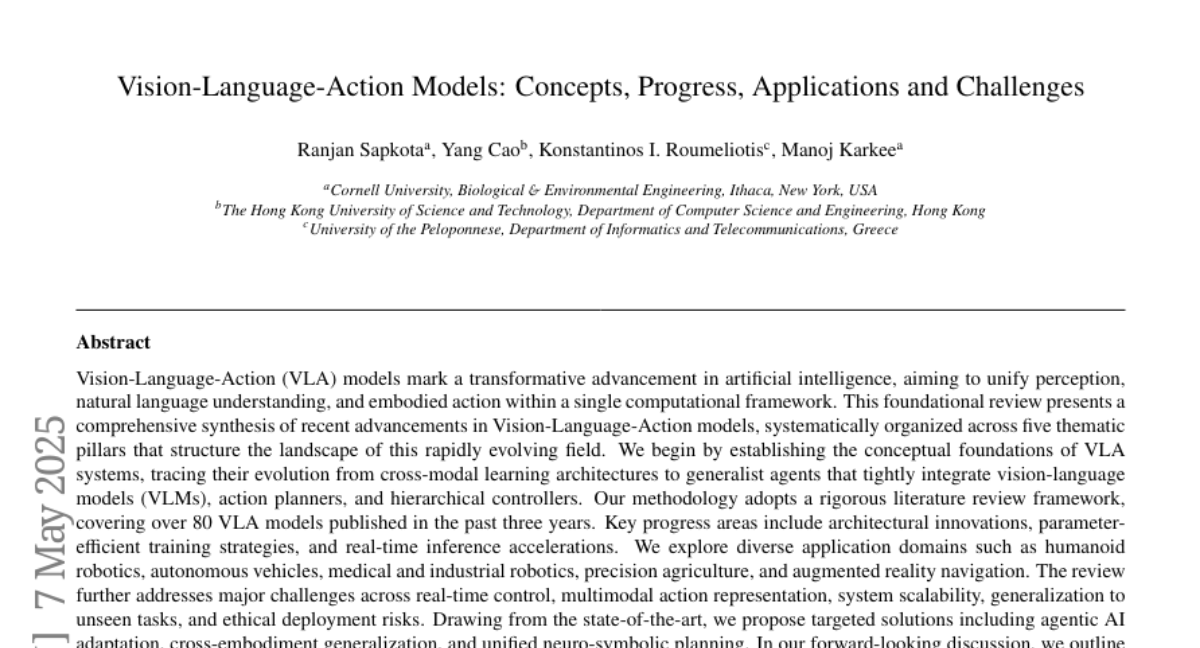
A comprehensive review presents advancements in Vision-Language-Action models, covering innovations, training strategies, and real-time applications across various domains, while addressing challenges and proposing future solutions.