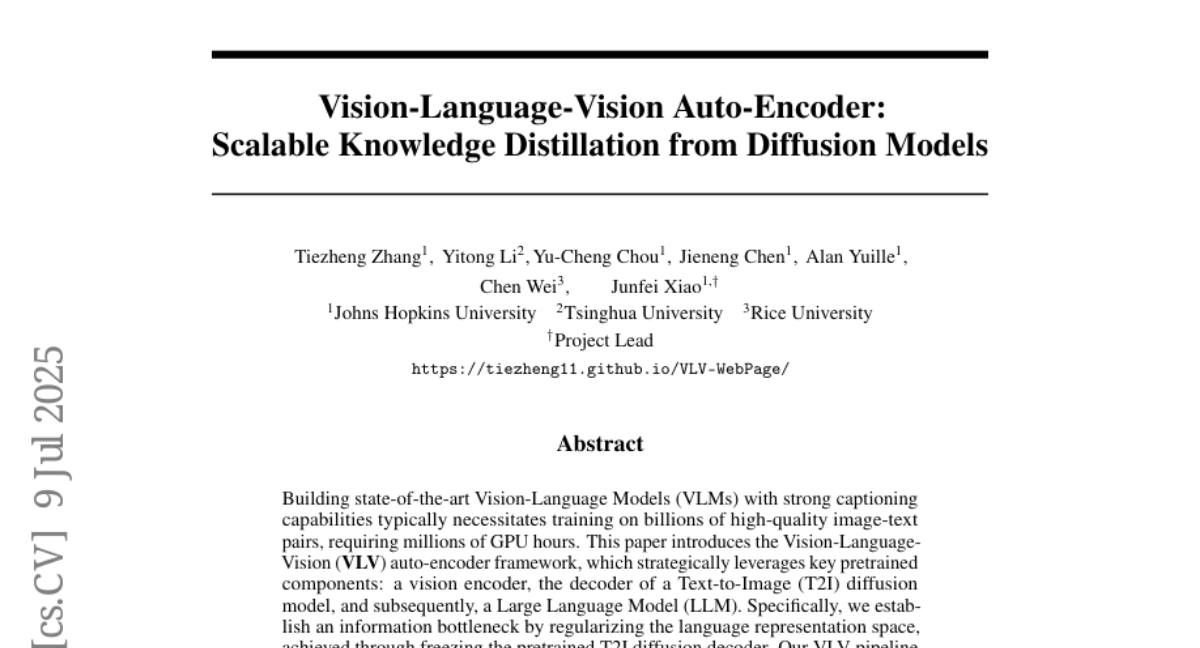
Vision-Language-Vision Auto-Encoder: Scalable Knowledge Distillation from Diffusion Models
Tiezheng Zhang, Yitong Li, Yu-cheng Chou, Jieneng Chen, Alan Yuille, Chen Wei, Junfei Xiao
2025-07-16
Summary
This paper talks about the Vision-Language-Vision (VLV) auto-encoder, a new system that uses pretrained image and text models to create a powerful captioning tool that describes images accurately and with less training data.
What's the problem?
The problem is that teaching AI to understand and describe images usually needs huge amounts of paired images and text data, which is expensive and time-consuming to gather and train on.
What's the solution?
The VLV auto-encoder solves this by using a pretrained text-to-image diffusion model as a decoder and a vision encoder to extract detailed image features into a compact language-like representation. Then, a pretrained large language model is fine-tuned to turn these representations into descriptive captions. This approach requires much less paired data and training effort while maintaining high caption quality.
Why it matters?
This matters because it makes building advanced vision-language models cheaper and easier, allowing more people to create AI that can understand and describe images well. It also leads to better AI that can generate detailed, meaningful descriptions and helps push the field of multimodal learning forward.
Abstract
The VLV auto-encoder framework uses pretrained vision and text models to create a cost-efficient, high-quality captioning system with reduced data requirements.