Visual Instruction Bottleneck Tuning
Changdae Oh, Jiatong Li, Shawn Im, Yixuan Li
2025-05-21
Summary
This paper talks about Visual Instruction Bottleneck Tuning, a new method that helps AI models that work with both images and text stay accurate and reliable even when they get new or unexpected types of data.
What's the problem?
The problem is that multimodal AI models, which handle both pictures and words, often get confused or make mistakes when they are given information that's different from what they were trained on, a situation known as a distribution shift.
What's the solution?
To solve this, the researchers used a mathematical approach called the information bottleneck principle, which helps the model focus only on the most important details needed to follow instructions. This makes the model more robust and less likely to get thrown off by new or unusual data.
Why it matters?
This matters because it means AI can be more dependable in real-world situations, where the information it sees is always changing, making it more useful for things like education, healthcare, and customer service.
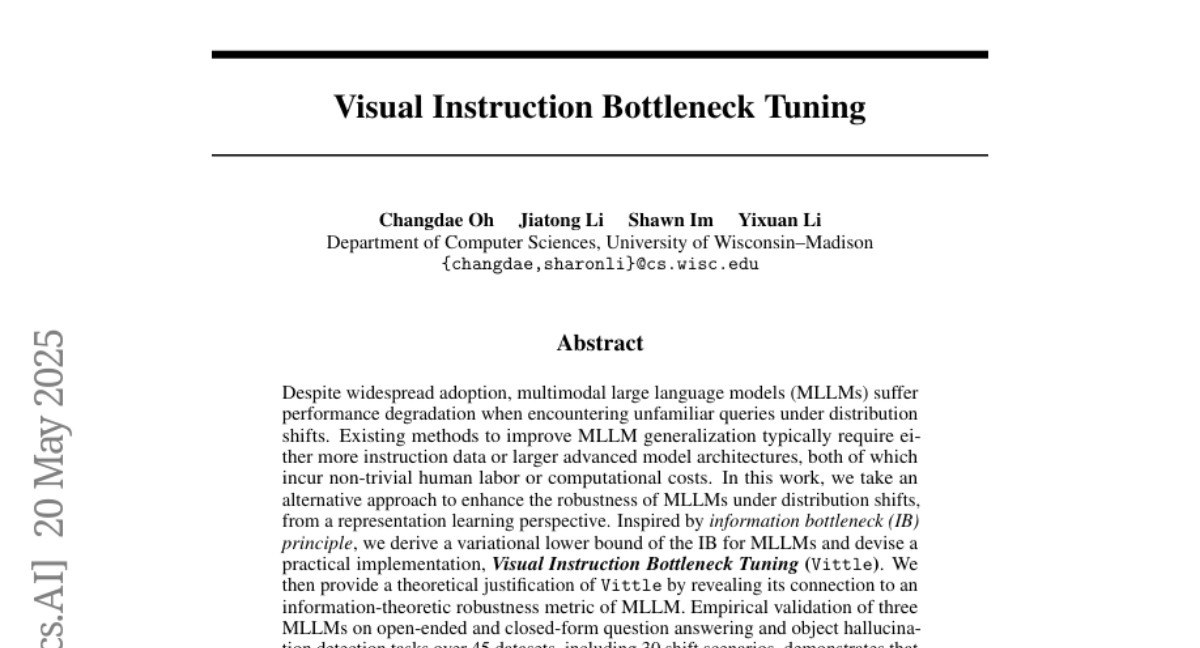
Abstract
A variational lower bound of the information bottleneck principle is implemented to enhance the robustness of multimodal large language models under distribution shifts.