What Makes a Good Natural Language Prompt?
Do Xuan Long, Duy Dinh, Ngoc-Hai Nguyen, Kenji Kawaguchi, Nancy F. Chen, Shafiq Joty, Min-Yen Kan
2025-06-15
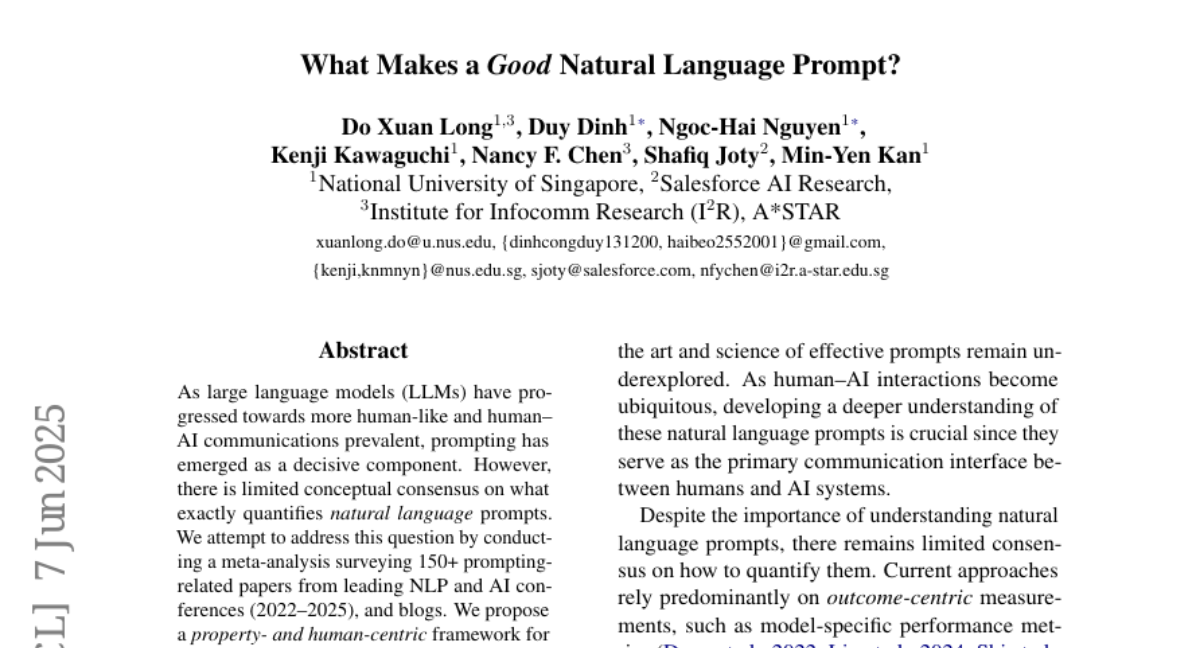
Summary
This paper talks about what makes a good natural language prompt for large language models. It proposes a detailed framework to evaluate and improve prompts based on many different qualities, helping to understand why some prompts work better than others in tasks where the model needs to think deeply.
What's the problem?
The problem is that while prompts are very important for guiding AI models to give useful answers, there hasn’t been a clear way to define or measure what makes a prompt good. Many studies look at prompts differently and don’t cover all the important features or their effects on reasoning tasks.
What's the solution?
The solution was to analyze over 150 research papers and create a framework that breaks down prompt quality into 21 properties across six main categories. This framework helps researchers see how these properties affect model performance, find connections among them, and recommend ways to improve prompts. They also tested how improving single prompt properties can help reasoning, and showed that training models on these improved prompts leads to better thinking.
Why it matters?
This matters because as AI is used more for complex communication and problem-solving, having a clear way to make and judge good prompts helps build smarter and more reliable AI systems. It bridges the gap between how humans communicate and how AI understands prompts, guiding future research in creating better AI interactions.
Abstract
A framework for evaluating and optimizing natural language prompts in large language models is proposed, revealing correlations between prompt properties and their impact on reasoning tasks.