WideRange4D: Enabling High-Quality 4D Reconstruction with Wide-Range Movements and Scenes
Ling Yang, Kaixin Zhu, Juanxi Tian, Bohan Zeng, Mingbao Lin, Hongjuan Pei, Wentao Zhang, Shuicheng Yan
2025-03-18
Summary
This is a collection of research paper titles focusing on recent advancements and challenges in AI, particularly in areas like image and video generation, language models, robotics, and multimodal learning.
What's the problem?
The main problems addressed involve improving the quality, efficiency, control, and understanding of AI-generated content, enhancing the reasoning abilities of AI models, mitigating biases and safety risks, enabling AI to better interact with the real world, and creating more personalized and versatile AI systems.
What's the solution?
The solutions involve developing new models, training techniques, benchmarks, and evaluation methods. Innovations include diffusion models, transformers, reinforcement learning, and multimodal learning. Specific solutions focus on improving image editing, generating consistent videos, enabling robots to navigate and manipulate objects, adding speech to text-based models, and making AI models fairer.
Why it matters?
These advancements are important because they push the boundaries of AI capabilities, making AI more powerful, reliable, and beneficial for various applications. They also address critical challenges related to safety, fairness, and transparency, ensuring AI is developed and used responsibly.
Abstract
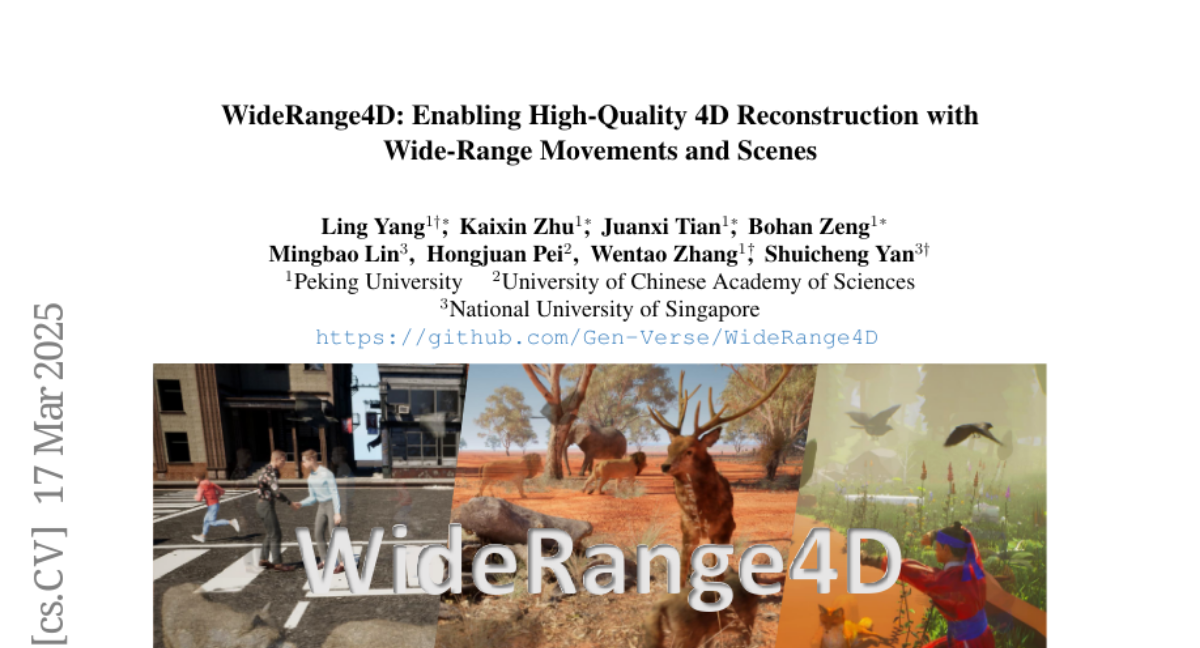
With the rapid development of 3D reconstruction technology, research in 4D reconstruction is also advancing, existing 4D reconstruction methods can generate high-quality 4D scenes. However, due to the challenges in acquiring multi-view video data, the current 4D reconstruction benchmarks mainly display actions performed in place, such as dancing, within limited scenarios. In practical scenarios, many scenes involve wide-range spatial movements, highlighting the limitations of existing 4D reconstruction datasets. Additionally, existing 4D reconstruction methods rely on deformation fields to estimate the dynamics of 3D objects, but deformation fields struggle with wide-range spatial movements, which limits the ability to achieve high-quality 4D scene reconstruction with wide-range spatial movements. In this paper, we focus on 4D scene reconstruction with significant object spatial movements and propose a novel 4D reconstruction benchmark, WideRange4D. This benchmark includes rich 4D scene data with large spatial variations, allowing for a more comprehensive evaluation of the generation capabilities of 4D generation methods. Furthermore, we introduce a new 4D reconstruction method, Progress4D, which generates stable and high-quality 4D results across various complex 4D scene reconstruction tasks. We conduct both quantitative and qualitative comparison experiments on WideRange4D, showing that our Progress4D outperforms existing state-of-the-art 4D reconstruction methods. Project: https://github.com/Gen-Verse/WideRange4D