WorldPM: Scaling Human Preference Modeling
Binghai Wang, Runji Lin, Keming Lu, Le Yu, Zhenru Zhang, Fei Huang, Chujie Zheng, Kai Dang, Yang Fan, Xingzhang Ren, An Yang, Binyuan Hui, Dayiheng Liu, Tao Gui, Qi Zhang, Xuanjing Huang, Yu-Gang Jiang, Bowen Yu, Jingren Zhou, Junyang Lin
2025-05-16
Summary
This paper talks about WorldPM, a new approach to teaching AI models to better understand and match what people like or prefer, by using much larger and more varied examples of human choices.
What's the problem?
The problem is that AI systems often have trouble accurately predicting or adapting to what different people prefer, especially when there isn't enough data or when the preferences are complicated and diverse.
What's the solution?
The researchers improved the way AI models are fine-tuned by giving them access to a huge amount of preference data from many different situations. This helps the models learn to handle tricky or challenging cases and generalize better to new types of human preferences.
Why it matters?
This matters because it makes AI more responsive and useful in real life, whether it’s recommending music, helping with decisions, or personalizing experiences, since it can better understand and adapt to what people actually want.
Abstract
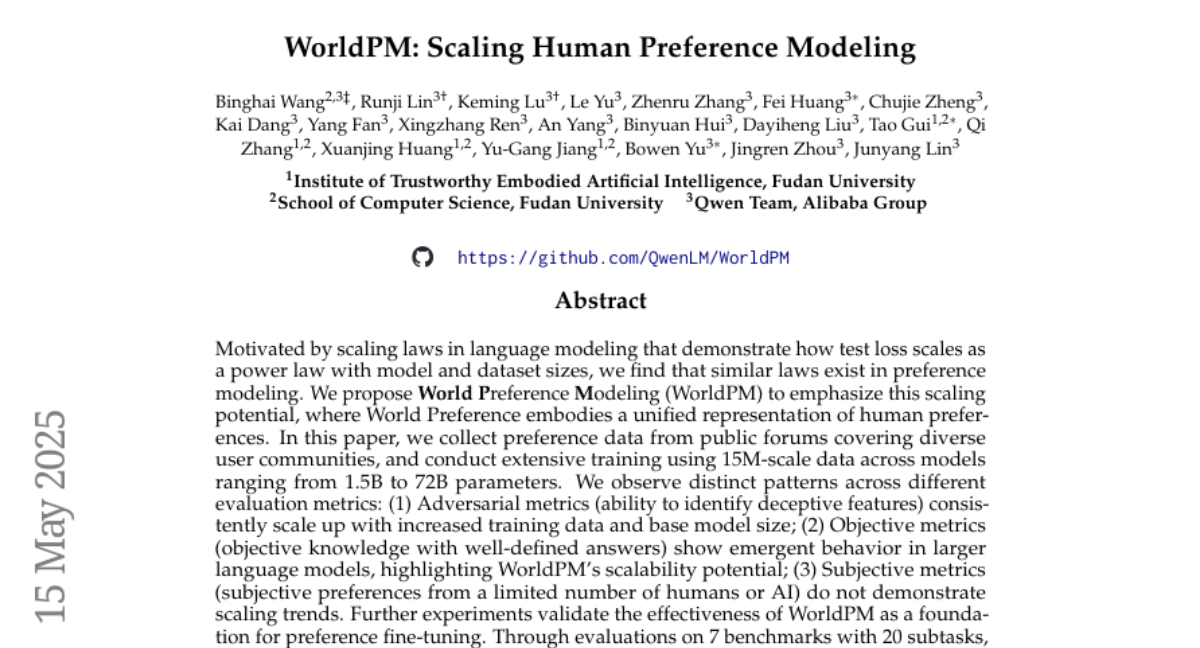
World Preference Modeling (WorldPM) enhances preference fine-tuning through large-scale preference data, showing scalability benefits in adversarial and objective metrics, and improving generalization across various human preference datasets.