ZipIR: Latent Pyramid Diffusion Transformer for High-Resolution Image Restoration
Yongsheng Yu, Haitian Zheng, Zhifei Zhang, Jianming Zhang, Yuqian Zhou, Connelly Barnes, Yuchen Liu, Wei Xiong, Zhe Lin, Jiebo Luo
2025-04-14
Summary
This paper talks about ZipIR, a new method for fixing and improving high-resolution images using advanced AI techniques. The system is designed to restore images that might be blurry, damaged, or low-quality, making them look sharp and clear again.
What's the problem?
The problem is that restoring high-resolution images with AI usually takes a lot of computer power and memory, making it slow and hard to use for really big images. Most current methods struggle to handle large images efficiently, which limits their usefulness for things like photography, movies, or scientific research.
What's the solution?
The researchers created ZipIR, which uses a special way of compressing images into a smaller, more manageable form called a latent space. They also introduced a Latent Pyramid VAE, which breaks down the image into different levels of detail, so the AI can work on the image more efficiently. This approach makes it possible to restore high-quality images quickly and with less computing power.
Why it matters?
This work matters because it allows people to fix and improve large, high-resolution images much more easily and affordably. Whether it's for professional photography, restoring old family photos, or improving visuals in movies and games, ZipIR makes high-quality image restoration available to more people and industries.
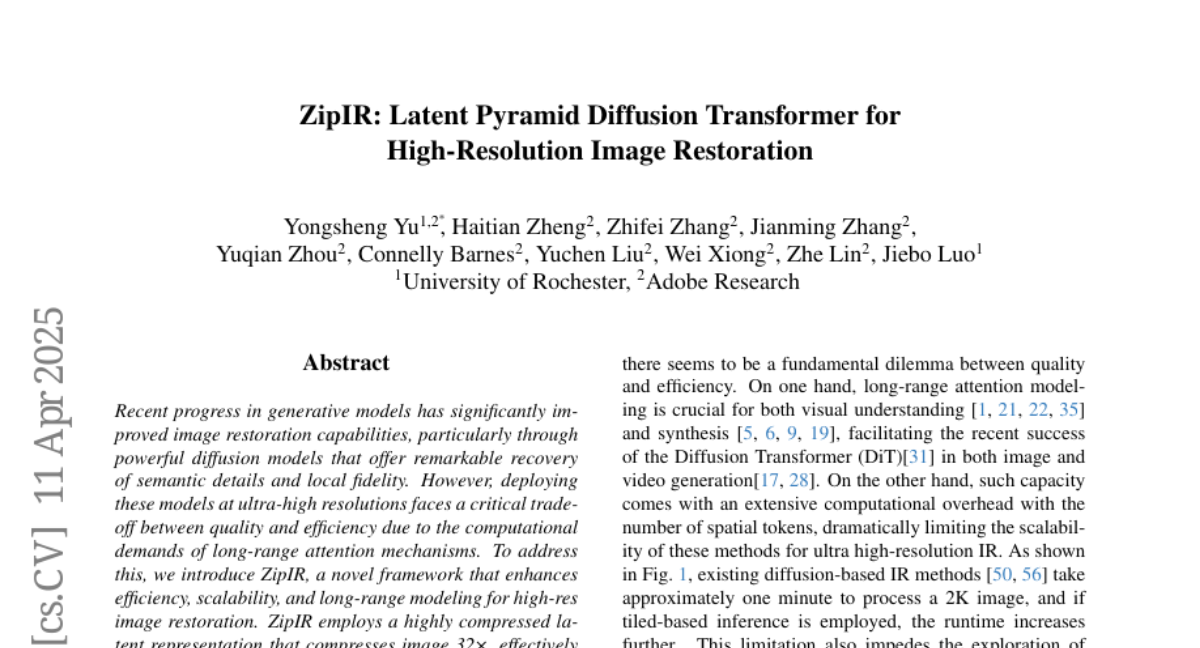
Abstract
ZipIR, a novel framework, uses a compressed latent space and Latent Pyramid VAE to enhance efficiency and scalability of diffusion models for high-resolution image restoration.